



Institutional reform will make Nigeria this century’s breakout economy
Lagos, Nigeria – 2nd October, 2026
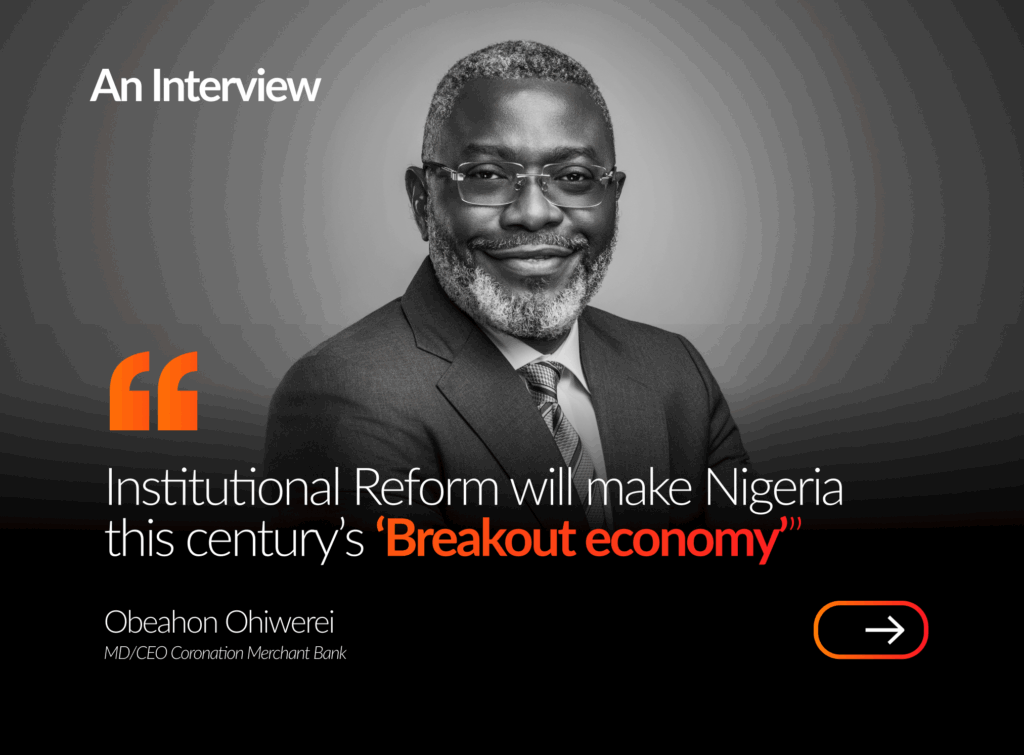
A veteran of Nigerian banking, Obeahon Ohiwerei brings over three decades of executive leadership – including stints as managing director of Keystone Bank and executive director at Access Bank – to his role as CEO of Coronation Merchant Bank. At the helm, he steers the firm’s ambition across corporate banking, advisory, and capital markets while driving digital transformation and regional expansion. In this interview with Stephen Onyekwelu, Ohiwerei outlines where Nigeria’s real economic opportunities lie – and how to capture them. Excerpts:
Nigeria’s economic reforms are reshaping the operating environment for businesses and investors. From your vantage point at Coronation Merchant Bank, what is the most important change in the economy today, and what does it mean for the next phase of private-sector growth?
The most important change is restoring market-based economic pricing, particularly in the foreign exchange (FX) market. Alongside fuel subsidy removal, fiscal consolidation, tax reforms, and monetary tightening, FX unification stands out because it corrects long-standing capital allocation distortions. Previous FX illiquidity and multiple rate windows created uncertainty, constrained foreign investment, and drove businesses toward short-term arbitrage over productive growth.
Recent policy adjustments have improved transparency, liquidity, and price discovery. Despite initial inflationary friction, investor confidence has strengthened. External reserves surpassed US$50 billion, and 2025 capital importation reached US$23.2 billion (up from US$12.3B in 2024 and US$3.9B in 2023). Moving forward, stabilisation must translate into real-sector expansion across power, gas, agribusiness, logistics, housing, healthcare, tech, and manufacturing.
Nigeria needs to move from macroeconomic stabilisation to sustained investment and productivity growth. What will it take for the financial system to translate greater economic stability into significantly more capital for businesses, infrastructure and productive assets?
Macroeconomic stability provides a foundation, but an efficient transmission mechanism is required to connect available capital – such as growing pension assets – with long-term real-economy needs. The financial system must prioritise developing patient, 10- to 20-year financing structures, including infrastructure funds, private credit platforms, and blended finance. Furthermore, project bankability, governance, and risk-sharing mechanisms must improve to move institutional capital off the sidelines.
Merchant banks sit at the intersection of capital providers and users. Beyond direct lending, institutions like Coronation Merchant Bank originate and structure complex infrastructure transactions, provide early financing, and distribute risk across capital markets via commercial paper, corporate bonds, or securitisation. This originates-and-distributes model recycles balance sheet capacity to continuously fund new projects at scale.
Merchant banks sit at the intersection of capital, corporate strategy and investment. Where do you see the biggest pools of capital for financing Nigeria’s next phase of growth, and what needs to change to unlock them at scale?
Four primary capital pools can drive Nigeria’s next expansion:
Domestic long-term savings: Over ₦30 trillion in pension and insurance assets suited for infrastructure and energy.
Global long-term capital: Sovereign wealth, global pension, and private equity funds seeking real returns in a predictable policy environment.
Development and transition capital: DFI and climate funds targeting energy access and sustainable infrastructure via blended-finance structures.
Private domestic enterprise capital: Corporate and family business resources mobilized through public listings, private markets, and strategic partnerships.
One of Nigeria’s enduring challenges is the mismatch between the country’s long-term development needs and the predominantly short-term nature of available capital. How should banks, institutional investors and policymakers address this financing gap?
The financing gap exists because short-term banking deposits are used to fund long-term infrastructure. Commercial banks excel at short-term working capital, whereas power plants, rail, and industrial parks require decades-long funding horizons. Solving this requires expanding specialized investment platforms (private credit, infrastructure funds, REITs) and relying on pension funds as long-term anchors.
Additionally, commercial banks should fund early project stages and refinance mature assets through capital markets. Developing deep domestic bond markets and infrastructure-linked securities allows capital to circulate efficiently without overleveraging banking balance sheets.
The private sector will carry much of the burden of financing Nigeria’s future infrastructure, industrial capacity and enterprise growth. Which sectors do you believe offer the strongest opportunities for capital deployment over the next five to ten years, and why?
The strongest opportunities combine urgent development needs with commercial returns across six key sectors:
Energy: Addressing power deficits through gas-to-power, grid expansion, and renewables, leveraging Nigeria’s natural gas reserves.
Logistics & Transport: Expanding ports, cold storage, and transport corridors under AfCFTA.
Agribusiness: Investing in processing, storage, and export value chains beyond primary farming.
Manufacturing: Focusing on import substitution, local value addition, and job creation.
Digital Economy & Housing: Scaling digital infrastructure, e-commerce, AI, and affordable urban housing.
Nigeria has a large pool of domestic savings, yet much of the economy remains undercapitalised. What reforms or innovations would enable the financial system to convert more domestic savings into long-term investment and wealth creation?
Domestic savings must be channeled away from low-risk, liquid short-term instruments into real-sector investments. Deeper corporate bond markets, private equity funds, and securitised products provide households and institutions with structured asset exposure.
Digital platforms lower entry barriers for retail investors, while financial literacy builds an investment mindset among younger demographics. Creating venture pathways for SMEs further unlocks domestic entrepreneurial capacity.
Technology is changing financial intermediation, while fintechs are expanding access and creating new business models. How do you see the relationship between traditional financial institutions, merchant banks and fintech companies evolving, and what will this mean for the competitiveness of Nigeria’s financial system?
The relationship is evolving toward collaboration rather than disruption. Fintechs bring agile customer acquisition, digital distribution, and alternative data analytics. Traditional and merchant banks contribute balance-sheet strength, regulatory expertise, risk management, and institutional trust.
Partnerships will expand SME lending via embedded finance and deepen capital market participation through digital distribution. This synergy enhances the international competitiveness of Nigeria’s financial ecosystem while maintaining regulatory stability.
As Nigeria marks 66 years of independence, what is your vision for the role of Coronation Merchant Bank in financing the Nigeria of the future, and what would you like business leaders, investors and policymakers to understand about the opportunity ahead?
Coronation Merchant Bank aims to catalyse Nigeria’s potential by connecting domestic and global capital to transformational projects in energy, logistics, tech, and manufacturing. As Nigeria moves toward becoming one of the world’s most populous nations by 2050, its demographic scale and urbanisation offer compelling long-term fundamentals.
Investors and policymakers should look beyond short-term inflationary pressures. Current structural reforms lay the groundwork for sustainable growth, rewarding institutions that systematically deploy capital into high-impact sectors.
About Coronation Merchant Bank
Coronation Merchant Bank was established in 2015 to provide wholesale banking to a long-underserved market. The Bank offers Corporate & Investment Banking, Private Banking/Wealth Management and Global Markets/Treasury Services to its niche clientele. It is the first and only merchant bank in Nigeria with an international risk rating (B- from Fitch). It presently has two branches in Abuja and Port Harcourt with its Head Office in Lagos, Nigeria.
The Bank has been the recipient of numerous international and national awards including Best Investment Bank in Nigeria by Global Finance, Best Investment Bank in Nigeria by World Finance, Best Investment Bank in Nigeria by Global Banking & Finance Review, Best Investment Bank by Global Business Outlook, Best Investment Bank in Nigeria by International Finance and Best Investment Bank in Nigeria at the BusinessDay Banking and Financial Institution Awards.