




What Markets Know Before Headlines Do: How market movements predict economic and business shifts before they become obvious.
Written by Ezinma Ileka
Chief Dealer, Global Markets & Treasury, Coronation Merchant Bank
Financial markets are not merely a mirror of economic reality. They are its leading edge. Before a recession becomes official, before a central bank speaks, before a boardroom senses trouble, markets have already priced in the turning point. Reading this predictive logic is not a speculative art. It is a structured discipline with measurable antecedents and significant implications for how executives, investors, and policymakers navigate uncertainty.
The Market as Information Processor
Every market transaction is a statement of belief about the future. When millions of such transactions are aggregated, each grounded in a distinct information set and a distinct view of what comes next, the resulting price embeds more collective intelligence than any single analyst, institution, or government body can independently generate. This is the foundational premise behind market predictiveness.
Not all market movements carry equal informational content. A single day’s volatility is often noise. A sustained, cross-asset repricing is a signal. Discipline lies in distinguishing between the two, and in identifying which instruments, in which configurations, have historically preceded which economic outcomes. Three have demonstrated particular reliability across multiple cycles: the yield curve, credit spreads, and currency dynamics. Each encodes a different dimension of economic expectation; together, they constitute a more complete picture than any one indicator read in isolation.
Three Instruments, One Conclusion
The shape of the yield curve
It has long been one of the most closely watched signals in fixed income markets, and Nigeria’s experience through the 2024-25 tightening cycle offered a vivid local illustration. As the CBN raised the Monetary Policy Rate sharply through 2024, short-tenor instruments, Nigerian Treasury Bills and OMO bills, began offering yields that at points exceeded those on longer-dated FGN bonds. That flattening, and in places inversion, of the naira curve was not an abstract technicality. It reflected the market’s view that the prevailing rate environment was unsustainable over the long run, that liquidity conditions were exceptionally tight in the near term, and that a future easing cycle was being priced in well ahead of any policy signal from the CBN. For treasury desks reading the curve in real time, the message was clear long before it appeared in commentary: duration positioning, deposit pricing, and funding strategy all needed to adjust to a regime where the front end of the curve, not the back end, was where the real opportunity sat.
Credit spreads tell a complementary story
Nigeria’s corporate bond market in 2024 provided a textbook case of credit markets signaling stress well before it became a headline. As the CBN’s tightening cycle pushed benchmark rates sharply higher, corporate bond issuance collapsed, by some measures to its lowest level in five years, as issuers found the cost of new debt prohibitive relative to the coupons on existing instruments. Long before commentators began writing about the crowding out of the private sector, the primary market itself was delivering the verdict: corporates that would ordinarily have come to market were staying away, and investor appetite was rotating toward sovereign paper. By 2026, the conversation had shifted again, toward a looming maturity wall of corporate bonds issued at the old, lower rates and now facing refinancing at substantially higher cost. The credit market was pricing that refinancing pressure into secondary market valuations months before it became a board-level concern for the issuers themselves.
Currency markets offer a third lens
The naira’s trajectory is instructive: long before formal exchange rate reforms were announced, the parallel market and offshore NDF pricing had already reflected the purchasing power differential that the official rate did not yet acknowledge. This is not a uniquely Nigerian dynamic. The Thai baht deteriorated ahead of the 1997 Asian crisis; the Turkish lira’s depreciation was visible in swap markets months before inflation prints made international news. The currency market spoke first, clearly, measurably, and with sufficient lead time for informed actors to respond.
What This Means for Decision-Makers
The practical implication is direct. GDP figures, inflation prints, and unemployment data are, by construction, backward-looking. They describe what has already occurred. Incorporating yield curve slope, credit spread trends, and forward exchange rate dynamics into strategic planning cycles provides a genuinely forward-looking complement, one that is continuously updated and priced by market players with strong incentives to be right.
The most powerful signals are cross-asset in nature. A combination of yield curve flattening, credit spread widening, and domestic currency depreciation carries far greater predictive weight than any single indicator read alone. Building institutional capability to monitor and interpret these inter-market relationships, within treasury functions, risk committees, and planning teams, is increasingly a source of competitive advantage. Organizations that invest in this analytical infrastructure consistently outperform those that respond reactively to volatility after the fact.
Intellectual honesty requires acknowledging the limits. These limitations do not diminish the value of market-reading as a discipline. They reinforce the principle that it should function as one rigorous input among several, not an infallible oracle, but the most responsive, incentive-aligned information source available to serious economic actors.
Conclusion
The relationship between market movements and economic outcomes is not coincidence. It is the product of a system in which millions of informed, market players continuously process dispersed information and express their assessments through the language markets understand: price.
For those who learn to read that language, yield curves, credit spreads, currency forwards, sector rotations, the economy does not arrive as a surprise. It arrives as confirmation. The headlines will catch up. They always do. The question is whether you will already have acted.
Disclaimer: This article is intended for informational and thought leadership purposes only. It does not constitute investment advice or a solicitation for any financial product. For more updates on our research reports and articles, email corporatecomms@coronationmb.com or call 0201-2797640
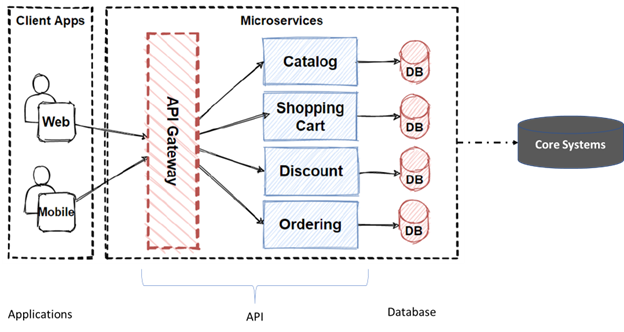
Explanation: An app or corporate system sends a request to the API gateway, which authenticates and routes it. The orchestration layer processes it using endpoints, pulling data from the core system via middleware.
The orchestration layer (behind the gateway) breaks services—like catalog, shopping cart, or ordering—into modular endpoints, like building blocks online shops can share securely. The modular endpoints connect these APIs to core systems, translating the requests into formats that can be processed by the core system. Companies also provide developer portals with clear documentation and sandbox environments, simplifying integration for partners.
This architecture can be built for scale. Banks process millions of transactions daily using load balancing to scale out resources, and distribute traffic in a dynamic fashion. This architecture could incorporate the use of in-memory databases and Queueing technologies to cache frequently used data for swifter processing. More so, this introduces rate limiting features which help isolate any problem areas without affecting the entire service as a whole.
Challenges abound. One of such is the existence of legacy systems as many banks and organizations often rely on decades-old mainframes (core systems), thus requiring a middleware solution to bridge old and new systems—a complex but critical step. Another recent challenge is the need to enforce data privacy expectations, this has made encryption and data masking a necessary action. Encryption in itself comes with its own attendant side-effects especially where applied on data without proper service governance. It can slow performance, so banks and organizations use caching and optimized data flows to balance speed and security. Compliance with CBN guidelines and Nigeria’s data privacy laws demands robust consent management and audit trails. Versioning APIs (e.g., /v1/payments) prevents disruptions when systems evolve.
Real-world examples highlight APIs’ impact. Coronation Merchant Bank built the Dangote ISOP Collection API to streamline payments for Dangote’s distributors. These payments were previously riddled with slow reconciliations and delayed cash flow. The API integrates payments directly into Dangote’s ERP system and thereby automating the process, reducing errors, and strengthening business ties. Another bank used a KYC API to verify customer identities for loan applications, cutting onboarding time while meeting CBN standards. A third example involves a major Nigerian bank’s payment API, which enables instant corporate transfers for retailers, ensuring funds clear in seconds during peak sales.
APIs are also driving open finance. The CBN’s 2023 guidelines expand APIs to cover credit, investment, and insurance data, enabling embedded finance—loans at retail checkouts or savings tools linked to salary accounts. This makes banking invisible yet ever-present, blending into daily life.
The future is exciting. Banks are adopting API-first design, prioritizing APIs as core interfaces for faster innovation. AI-driven APIs are emerging, enabling fraud detection or tailored loan offers. Blockchain-based APIs promise secure cross-border payments. Event-driven architectures, using tools like Kafka, process real-time events like transaction alerts, boosting efficiency.
At Coronation Merchant Bank, our APIs are business enablers. Our custom solutions, like the Dangote integration, solve real-world problems, while our investment banking desk advises on capital raising and partnerships, helping clients stay competitive. APIs lower barriers, drive growth, and deliver seamless experiences for customers.
Nigeria’s financial future isn’t about who holds the most assets—it’s about who builds the strongest connections between data, money, and people. API architecture is the invisible engine powering that future, creating a connected, inclusive banking ecosystem.